


2026.11.13
Food news
Freshness Matters for Fish—and for English? Taking on the Challenge of Online English Lessons
Do you ever use English at work?
For a trading company like ours, English is an essential tool. About half of the North American customers I work with are Japanese chefs, while the other half are chefs from other countries. I regularly use English on chat and by email, and even stronger English communication skills are needed when I travel overseas for business.
That said, actually speaking English can be difficult.
I can generally understand written English, but when native speakers talk to each other, the conversation can move so quickly that I often find myself wondering, “What did they just say?”
The fresh seafood we handle also involves many techniques and terms unique to Japan, such as “ikejime” and “shinkeijime.” To help customers properly understand our products, I feel that knowledge of fish alone is not enough—we also need the English skills to communicate that knowledge clearly.
With that in mind, since last year our company has offered online English conversation lessons as part of our employee benefits program.
We can take six 25-minute lessons per month and choose our own instructors. Many of the instructors are from the Philippines, and each has a different teaching and speaking style. Even with the same lesson materials, every instructor approaches them differently, which is part of what makes the lessons interesting.
I sometimes take lessons at around 7:00 a.m. Japan time, when it is still very early in the Philippines. Some instructors even start teaching at 5:00 or 6:00 a.m. local time.
Because of this, I sometimes hear a rooster crowing loudly in the background during a lesson! (laughs)
It surprised me at first, but now it has almost become a familiar part of my lessons—a little sign that another morning has begun in the Philippines.

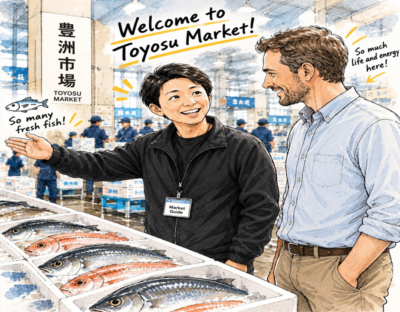
We also occasionally show overseas customers around Toyosu Market when they visit Japan.
At first, I thought I would have to memorize the English names of all the different fish. But I was surprised to find that many Japanese fish names, such as “Hamachi,” “Kanpachi,” and “Madai,” are already commonly understood.
On the other hand, it becomes much more difficult when I need to explain things such as when a fish is in season, how it was caught, or why its quality is so good.
Once, while showing a customer around Toyosu, I was asked about the characteristics of a fish. I could not find the right words in English on the spot, so I ended up repeating, “Very good fish!” and “Very fresh!” several times. Going forward, I hope to put what I learn in my English lessons into practice and become better at explaining our fish in greater detail.
“This fish is at its best in May.” “This fish was caught by trolling.” “We carefully check the freshness and quality at the market, select the best fish, and use the most suitable packing method for each type of fish to maintain its freshness.”
Learning more advanced expressions is important, but for now, my goal is to communicate clearly and accurately, even if I use short and simple sentences.
I will continue working on my English skills every day so that I can build even better relationships with customers around the world.
【Contact Information】
Itabashi Trading Co., Ltd.
Food Division
TEL: +81-3-3248-1016 (Weekdays 10:00–17:00, GMT+8:00)
FAX: +81-3-3248-1008
E-MAIL: shokuhin@itabashi-trading.com